
Categories
History, Sarasota, FL, Things to do, WildlifePublished August 25, 2026
Myakka River State Park: The Canopy Walkway, Deep Hole & a Journey Into Wild Florida

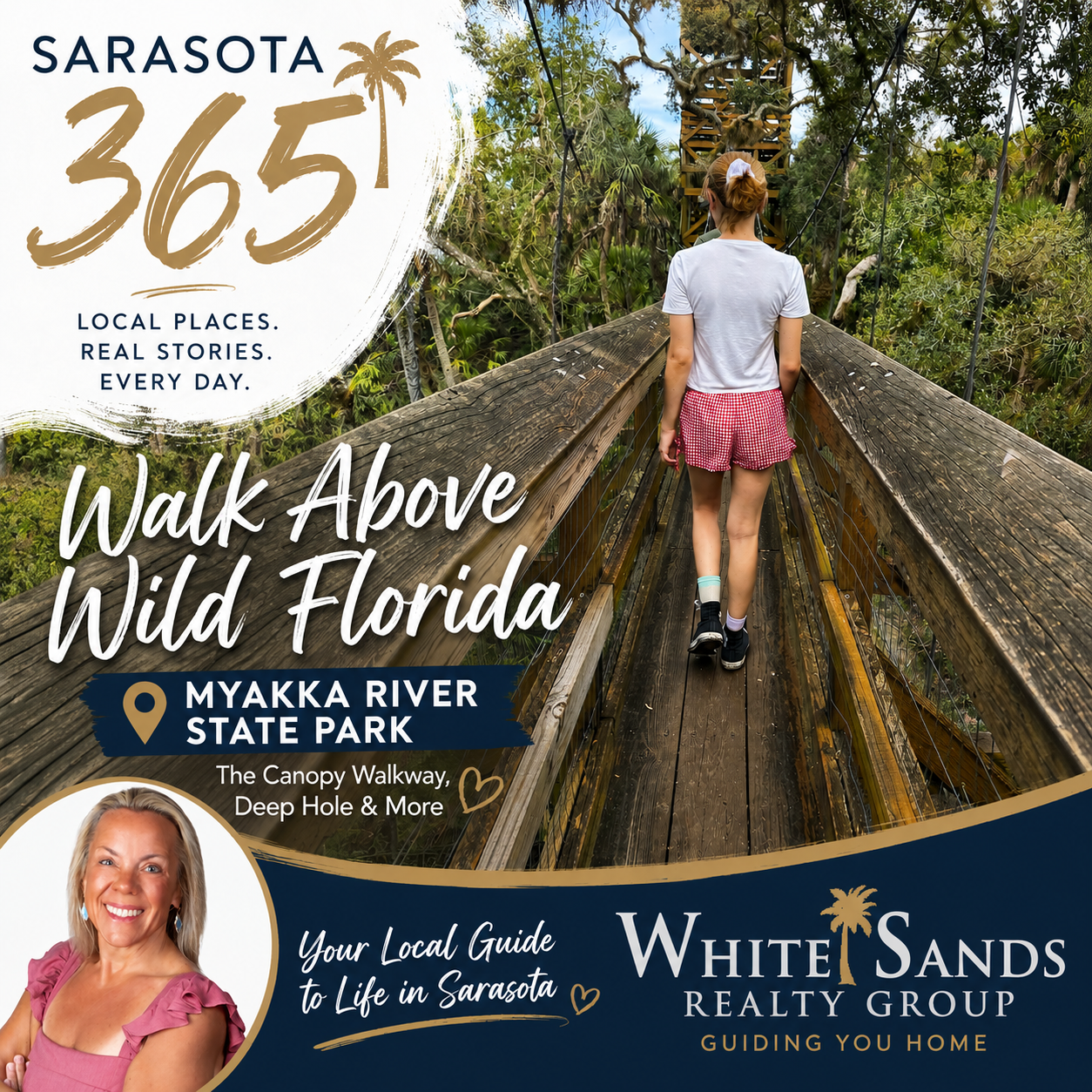
Myakka River State Park: The Canopy Walkway, Deep Hole & a Journey Into Wild Florida
There is a side of Sarasota that has nothing to do with white-sand beaches, waterfront restaurants or manicured neighborhoods.
Drive east from the coast and the landscape begins to change. Buildings disappear. The horizon gets wider. Live oaks stretch over the road, cabbage palms rise from the prairie, and dark, tea-colored water winds through wetlands where alligators, turtles and wading birds have been living their lives long before the first vacationer ever discovered Sarasota.
Welcome to Myakka River State Park, one of the best places in Southwest Florida to experience what locals often call “Old Florida.”
At more than 37,000 acres, Myakka River State Park is one of Florida's oldest and largest state parks. The Myakka River winds through an extraordinary landscape of wetlands, hammocks, pinelands and vast expanses of Florida dry prairie. It is also part of an even larger conservation landscape known as “Myakka Island,” encompassing more than 80,000 acres of protected lands in Sarasota and Manatee counties.
And while you could easily spend an entire day simply driving, hiking, biking, birdwatching or photographing wildlife here, three experiences make Myakka especially memorable:
the Myakka Canopy Walkway, the observation tower, and the mysterious Deep Hole.
This Is a Very Different Sarasota
Sarasota is famous for the Gulf of Mexico, but Myakka shows you an entirely different side of the region.
The landscape here feels enormous.
Depending on the season, you may encounter flooded marshes shimmering in the sunlight, nearly dry prairie stretching toward the horizon, wildflowers blooming across open grasslands or clusters of birds gathered around shrinking bodies of water.
The park changes dramatically with Florida's wet and dry seasons. Summer rainfall fills the river and surrounding floodplain, while winter and spring bring progressively lower water levels. In particularly dry periods, sections of the river can become extremely shallow or even dry.
That seasonal rhythm is one reason no two visits to Myakka are quite the same.
Wildlife sightings can include alligators, deer, wild turkeys, feral hogs, turtles and an extraordinary variety of birds. Ospreys, limpkins, vultures, herons, egrets, hawks, sandhill cranes and other species are frequently seen throughout the park.
For photographers and birdwatchers, Myakka can be remarkable.
For someone visiting Sarasota for the first time, it can be downright unexpected.
The Myakka Canopy Walkway
Hidden inside an oak-and-palm hammock is one of Myakka's most unusual attractions.
The Myakka Canopy Walkway was completed in 2000 and is recognized as the first public treetop trail in North America.
The project was inspired by renowned canopy scientist Dr. Margaret “Canopy Meg” Lowman and developed through a partnership involving the Florida Park Service, Friends of Myakka River, the TREE Foundation and community supporters.
Unlike an ordinary hiking trail, this one takes you into the trees.
The suspended walkway stretches approximately 100 feet through the hammock and hangs about 25 feet above the forest floor.
It's not an extremely long bridge, and that occasionally surprises first-time visitors, but the bridge itself isn't really the finale.
The tower is.
Climb 74 Feet Above Myakka
At one end of the walkway stands a tower rising approximately 74 feet above the ground.
Getting to the top means climbing more than 100 steps, Florida State Parks lists 112, but those who make the climb are rewarded with one of the most unusual views in Sarasota County.
Instead of looking at the trees, you're looking across and over them.
From the top, the landscape opens into layers of oak and palm hammock, wetlands, marshes and prairie.
There are no beachfront condominium towers on the horizon.
No amusement rides.
No elaborate observation deck.
Just Florida.
Look carefully and you may see vultures circling below or near your eye level, raptors moving over the prairie or birds disappearing into the treetops.
It's a perspective most people rarely get to experience.
Getting to the Canopy Walkway
The walkway is reached from the William Boylston Nature Trail.
The complete nature trail is approximately 0.8 mile, but visitors who primarily want to experience the canopy walkway can take a shorter route of only a few hundred yards.
That makes the canopy area relatively easy to incorporate into a larger day at Myakka.
The tower itself is another matter. You'll need to be comfortable climbing stairs, and the suspension walkway naturally has some movement beneath your feet.
Recent visitor reviews repeatedly describe the canopy experience as short but worthwhile, with the observation tower being a favorite part of the experience.
One important distinction: dogs may be permitted on the Boylston Nature Trail under park rules, but pets should not be taken onto the Canopy Walkway structure itself.
Then There Is Deep Hole
If the Canopy Walkway is Myakka's most recognizable attraction, Deep Hole may be its most fascinating.
Deep Hole lies near the southern end of Lower Myakka Lake inside the park's protected Wilderness Preserve.
And getting there is intentionally more difficult.
This is not an attraction with a boardwalk, gift shop and viewing platform.
It is wilderness.
Deep Hole is a natural sinkhole approximately 131 feet deep, making it dramatically deeper than the surrounding shallow lake and wetlands.
Its depth creates something extremely important during Florida's dry season: persistent deep water.
When surrounding waters recede, fish and other aquatic life become concentrated around Deep Hole.
And where there is concentrated prey in Florida, predators follow.
Including alligators.
Sometimes a remarkable number of them.
Why Are There So Many Alligators at Deep Hole?
The photographs from Deep Hole can look almost unbelievable.
During favorable conditions, particularly when surrounding water levels are low, large numbers of alligators may congregate around the remaining deep water.
Birds gather there as well, along with fish and other wildlife.
But there's an important point that sometimes gets lost on social media:
Deep Hole is not an alligator attraction.
It is a functioning natural ecosystem.
There is no guarantee that you'll encounter the dramatic numbers shown in photographs or videos. Water levels, temperature, weather, season and wildlife behavior all affect what visitors see.
That unpredictability is part of what makes the experience extraordinary.
Nothing has been staged.
Nothing has been placed there for tourists.
You're visiting the animals' habitat.
Scientists Have Actually Explored Deep Hole
Deep Hole is fascinating below the surface, too.
Researchers have studied its geology and water chemistry, and technical divers have descended into the sinkhole to better understand what lies beneath the dark water.
UF/IFAS Sarasota County describes research conducted with participants from organizations including Mote Marine Laboratory, Sarasota County Water Resources and the ADM Exploration Foundation.
And this wasn't exactly a casual snorkeling expedition.
Because Deep Hole is dark, deep and located in alligator habitat, researchers used specialized diving procedures and even had a submerged backup shark cage available as a safety measure.
It is one of those details that makes Deep Hole seem even more mysterious.
You can stand on the edge looking across an otherwise quiet Florida landscape while knowing that beneath that dark water is a sinkhole dropping more than a hundred feet below the surface.
You Need a Permit to Visit Deep Hole
This is extremely important.
You cannot simply decide to hike to Deep Hole and head down the trail.
Deep Hole is within Myakka River State Park's Wilderness Preserve, where access is deliberately restricted to protect the habitat and preserve the wilderness experience.
Florida State Parks currently limits access south of State Road 72 to 30 people per day.
Visitors must register at the ranger station on the day they intend to enter the Wilderness Preserve.
Because availability is limited, anyone specifically hoping to hike to Deep Hole should contact the park before visiting to confirm current procedures, trail conditions and access requirements.
And don't assume that because you visited previously, the rules or conditions will be exactly the same on your next trip.
This is genuine Florida wilderness. Weather, flooding, drought, prescribed burns and environmental conditions can all affect access.
The Hike to Deep Hole Is Part of the Adventure
Deep Hole is not a roadside stop.
Expect roughly a two-plus-mile hike each way, depending upon the route and current access, meaning the experience can easily become a four-to-five-mile outing.
And don't picture a shady forest walk.
Much of the route travels through open Florida prairie.
That means sun.
A lot of sun.
Depending on the season, it can also mean heat, humidity, insects, mud or standing water.
There are no concession stands waiting at Deep Hole.
No air-conditioned visitor center.
No convenient restroom halfway through your hike.
Bring plenty of drinking water, sun protection, insect repellent when appropriate, sturdy comfortable footwear and anything else you'll reasonably need for several hours outdoors.
And leave the wildlife alone.
About Those Alligators...
Myakka is one of the best places in the Sarasota area to observe wild alligators.
The key word is wild.
An alligator lying motionless along a shoreline may look relaxed, but visitors should never approach, feed, harass or attempt to pose closely with one.
Give wildlife plenty of room.
Keep children close.
Follow all park and ranger instructions.
Stay aware around shorelines and waterways.
And remember that Deep Hole is very different from observing an animal from behind a barrier at a zoo.
You are the visitor in their environment.
Respecting that fact is what keeps both people and wildlife safer.
Don't Skip the Birdwalk
If you love wildlife but aren't ready for the trek to Deep Hole, Myakka's Birdwalk is another worthwhile stop when open.
The boardwalk extends into the freshwater wetland environment, allowing visitors to move from hydric hammock toward the open marsh.
Bring binoculars.
Depending upon water levels and season, you may see alligators, wading birds, raptors and numerous other species.
Benches and interpretive signage make this a slower, easier place to simply stop and observe what's happening around you.
For birdwatchers, that can turn into a very long “quick stop.”
Drive Slowly, The Road Is Part of the Experience
One of my favorite things about Myakka is that you don't necessarily need an elaborate itinerary.
Sometimes the best plan is simply to slow down.
Drive through the park with your windows down.
Stop at overlooks.
Walk to the river.
Look into the trees.
Scan the shoreline.
Pull over where permitted when you see other visitors quietly watching something, there's often a reason.
Some of the most memorable wildlife encounters happen when you aren't looking for anything in particular.
That's part of Myakka's charm.
Hiking, Biking and Paddling
For visitors who want more than sightseeing, Myakka offers plenty of ways to explore.
Miles of trails and backroads invite hikers and bicyclists deeper into the landscape, while the Myakka River and Upper Myakka Lake provide opportunities for canoeing and kayaking when water conditions allow.
Paddlers can access the river and lake from designated areas, but water levels vary enormously throughout the year.
During high water, the river can have a surprisingly strong current.
During dry periods, sections may become difficult to navigate and portaging may be necessary.
Anyone planning a paddling trip should check conditions before launching.
Accessing waterways south of State Road 72 also requires a Wilderness Preserve permit.
A Park Built During the Great Depression
Myakka isn't only a natural treasure.
It's an important piece of Sarasota history.
Before becoming protected parkland, portions of the Myakka Valley were associated with ranching, including land connected with Bertha Palmer, the influential Chicago businesswoman whose investments played an enormous role in Sarasota's early development.
During the Great Depression, Florida acquired thousands of acres to create what would become Myakka River State Park.
The Civilian Conservation Corps, established as part of President Franklin D. Roosevelt's New Deal, arrived in the Myakka Valley in the 1930s.
The CCC workers built roads, trails, bridges and structures throughout the emerging park.
Their craftsmanship remains visible today.
An Important Part of Myakka's Story
There is another part of that history worth knowing.
After Sarasota initially resisted the placement of a Black CCC corps in the community in 1935, CCC operations at Myakka were temporarily shut down.
Sarasota eventually accepted the Black corps, and beginning later that year, many of the men who built Myakka River State Park were African American.
Working through extreme heat, insects, primitive conditions and racial discrimination, these men helped construct the infrastructure that generations of visitors still enjoy.
The park's visitor center, pavilions, roads, trails and historic palm-log cabins are part of that legacy.
Myakka River State Park formally opened to the public in 1941.
Knowing that history gives the park another dimension.
You're not simply walking through a preserved landscape.
You're also walking through an important chapter of Sarasota and Florida history.
Spend the Night in a Palm-Log Cabin
For an entirely different Myakka experience, consider staying overnight.
Five historic cabins originally built by the Civilian Conservation Corps remain available for overnight guests.
Constructed from palm logs harvested within the park, the cabins blend rustic CCC architecture with modern conveniences.
The park also offers developed camping and primitive camping opportunities.
Spending the night changes the experience considerably.
Day visitors disappear.
The temperature drops.
The sounds change.
And Myakka begins to feel much farther away from Sarasota than it actually is.
When Is the Best Time to Visit Myakka?
There really isn't one perfect season because Myakka's personality changes throughout the year.
Late fall through early spring generally offers cooler temperatures and more comfortable hiking conditions. As the dry season progresses and water levels recede, wildlife can become concentrated around remaining water sources.
Spring can offer excellent wildlife viewing but also increasingly warm temperatures.
Summer transforms the landscape. Afternoon thunderstorms and heavy rains replenish wetlands and floodplains, creating lush scenery and higher water levels — along with Florida heat, humidity and insects.
Fall can bring wildflowers and spectacular prairie landscapes.
For a longer hike such as Deep Hole, cooler months and an early start are generally much more comfortable.
For photography, birding or simply watching the landscape change, there is something worth seeing in every season.
What Should You Bring?
For an ordinary day exploring Myakka, consider bringing:
- Plenty of drinking water
- Sunscreen
- Sunglasses and a hat
- Comfortable walking shoes
- Insect repellent
- Binoculars
- A camera or fully charged phone
- Snacks or a picnic
- A park map
- A portable phone charger if you'll be exploring for several hours
For the Deep Hole hike, water and sun protection become necessities rather than suggestions.
Cell service can also be unreliable in natural areas, so don't make your phone your only navigation or emergency plan.
A Great Myakka Day for First-Time Visitors
If you've never been to the park before, you don't have to conquer every trail.
A wonderful first visit might look something like this:
Arrive in the morning and stop at the ranger station or visitor center for current conditions.
Drive slowly into the park, stopping at the river and wildlife-viewing areas.
Walk the William Boylston Nature Trail to the Canopy Walkway.
Cross the suspension bridge.
Climb the observation tower.
Spend some time watching wildlife around the wetlands and Upper Myakka Lake.
Visit the Birdwalk if conditions and access allow.
Bring lunch or a picnic and give yourself time to simply sit somewhere beautiful.
If you're an experienced hiker and specifically want to visit Deep Hole, make that the focus of a separate early-morning visit so you aren't trying to squeeze a wilderness hike into an already packed sightseeing day.
Know Before You Go
Myakka River State Park is located at:
13207 State Road 72
Sarasota, Florida 34241
The park is generally open 8 a.m. until sunset, 365 days a year.
The North Gate has more limited operating days and hours, so most first-time visitors should plan around the primary State Road 72 entrance unless they've confirmed otherwise.
Entrance fees, rentals, concessions, tours, water conditions, trails and individual facilities can change.
Before making a special trip, particularly for Deep Hole, paddling, boat tours or a specific attraction, check the official Florida State Parks page or contact the ranger station for current conditions.
One More Important Tip: Don't Rush Myakka
Myakka isn't the kind of place where you should arrive, photograph the sign, climb the tower and immediately leave.
Give it some time.
Stand quietly beside the river.
Listen for the limpkins.
Watch an osprey circle overhead.
Look across the prairie and imagine Sarasota before subdivisions, interstate highways and high-rise buildings.
Walk underneath live oaks that have been standing there longer than any of us.
And if you're lucky enough to receive one of the limited permits to Deep Hole, experience it for what it actually is, not an alligator attraction, but one small part of a vast natural system that still functions largely according to its own rules.
Why Myakka River State Park Belongs on a Sarasota Bucket List
Siesta Key may show you the Sarasota that appears on postcards.
St. Armands gives you Sarasota's sophisticated side.
Downtown introduces you to its arts and culture.
But Myakka River State Park shows you the landscape that was here before all of it.
That's what makes it special.
You can walk through the treetops on North America's first public treetop trail.
Climb 74 feet above an oak-and-palm hammock.
Hike across open prairie to a 131-foot-deep sinkhole where wild alligators gather.
Paddle a state-designated Wild and Scenic River.
Stand inside buildings constructed by Civilian Conservation Corps workers nearly a century ago.
Or simply sit beside the water and watch Florida behave like Florida.
And in a region that continues to grow and change, having more than 37,000 acres where wild Florida is still allowed to be wild feels increasingly extraordinary.
That's the magic of Myakka.
Sarasota 365 Local Tip
If you're introducing out-of-town guests to the Sarasota area, pair a Myakka morning with one of our famous Gulf Coast sunsets later in the day.
In the space of a few hours, they'll experience two completely different versions of Florida: alligators and prairie beneath ancient live oaks in the morning, and palms silhouetted against the Gulf of Mexico at sunset.
That's a pretty spectacular way to understand why so many of us love living here.
Always verify current park hours, entrance fees, trail conditions, Wilderness Preserve access, facility closures and water conditions with Florida State Parks before visiting. Wildlife sightings are never guaranteed, and all wildlife should be observed from a safe and respectful distance.

Michael Burke
| White Sands Realty Group Florida
or another way