
Categories
Property Tax Reform, Buyer Tips, RelocationPublished August 13, 2026
Moving to Florida in 2026? Why December 31 Could Be an Important Date for Homebuyers

Moving to Florida in 2026? Why December 31 Could Be an Important Date for Homebuyers
If you've been thinking about making Florida your permanent home, 2026 could turn out to be an especially important year to make that move.
Whether you're considering Sarasota, Venice, Nokomis, North Port, Port Charlotte, Siesta Key, Longboat Key or another community along Florida's Gulf Coast, a proposed change to Florida's Homestead Property Tax Exemption could make December 31, 2026 an important date for future Florida residents.
Florida voters are expected to decide in November 2026 whether to significantly increase the homestead exemption applicable to certain non-school property taxes.
If the amendment is approved by voters, the difference between establishing permanent Florida residency by December 31, 2026 and establishing it afterward could have meaningful property-tax implications.
What Is Florida's Homestead Exemption?
Florida's Homestead Exemption provides property-tax benefits to qualifying homeowners who own and make a Florida property their permanent residence.
It's one of the reasons understanding the difference between owning a second home in Florida and establishing a Florida homestead is so important.
The proposed constitutional amendment would substantially increase the amount of a qualifying homestead's assessed value that is exempt from certain non-school property taxes.
What Would Change If Florida Voters Approve the Amendment?
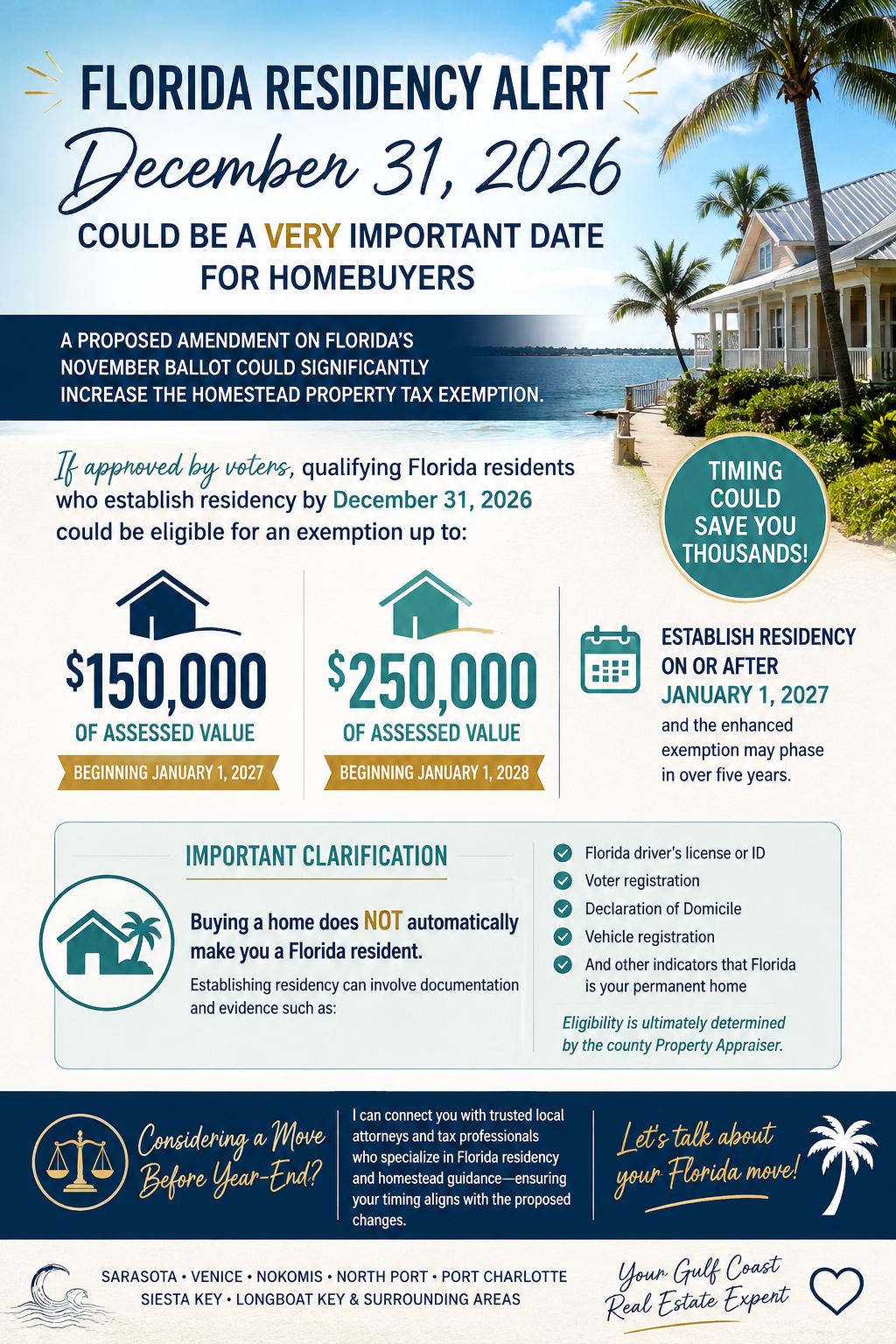
Under the proposal, qualifying individuals who maintained permanent Florida residence as of December 31, 2026 and establish homestead could receive an exemption from non-school ad valorem taxes of up to:
$150,000 of assessed value beginning January 1, 2027
and
$250,000 of assessed value beginning January 1, 2028.
Beginning in 2029, the enhanced exemption would also be adjusted for positive inflation growth as provided under the proposal.
It's important to understand that these amounts represent an exemption from a portion of the property's assessed value. They do not represent a $150,000 or $250,000 reduction in your tax bill.
The actual financial benefit would depend on factors including your property's assessed value, applicable exemptions and local tax rates.
Why December 31, 2026 Matters
This is where the proposed amendment becomes particularly relevant to people already considering relocating to Florida.
Under the proposal, someone who maintains permanent Florida residence by December 31, 2026 could potentially qualify for the enhanced exemption once the other homestead requirements are satisfied.
People who do not establish permanent Florida residence until January 1, 2027 or later would initially receive a smaller exemption from non-school taxes.
Under the proposal, they would not become eligible for the same enhanced exemption available to pre-2027 Florida residents until beginning with the fifth year of their exemption, subject to the provisions of the amendment and implementing Florida law.
For someone who was already planning to relocate to Florida, that makes the timing worth discussing with qualified real estate, legal and tax professionals.
Buying a Florida Home Doesn't Automatically Make You a Florida Resident
This distinction is extremely important.
Purchasing a house or condominium in Florida does not, by itself, automatically establish Florida residency or guarantee that a property qualifies for homestead exemption.
Florida looks at whether the property is your permanent residence, and establishing that residency can involve multiple forms of documentation and evidence.
Depending on your circumstances, those may include items such as:
- A Florida driver's license or identification card
- Florida voter registration
- Florida vehicle registration
- A Declaration of Domicile
- The address used for financial and government records
- Other documentation demonstrating that Florida is your permanent home
Homestead eligibility is ultimately determined by the appropriate county Property Appraiser.
That's why buyers who are considering relocating to Florida shouldn't rely solely on a real estate closing date when making residency or tax decisions.
What About Florida's Schools?
Another important distinction is that the proposed enhanced exemption applies to non-school ad valorem property taxes.
The proposal does not simply eliminate a homeowner's entire property-tax bill, and school district levies are treated differently.
That's an important point because headlines referring to a "$250,000 homestead exemption" can easily give consumers the wrong impression about how much they might actually save.
Does This Mean You Should Rush to Buy a Florida Home?
Not necessarily.
A real estate purchase should make sense based on your financial circumstances, lifestyle, goals and long-term plans — not simply because of a potential change in tax law.
However, if moving to Florida was already part of your plan, the December 31, 2026 residency provision is absolutely something worth discussing with your professional advisors.
There could be a meaningful difference between someone who establishes permanent Florida residence before the end of 2026 and someone who waits until 2027.
That makes planning ahead especially important.
The Amendment Still Has to Be Approved
This may be the most important disclaimer of all:
The proposed amendment is not currently in effect.
Florida voters must approve the constitutional amendment before these enhanced exemptions can become law.
So while it makes sense to understand the proposal and plan ahead, buyers should not make financial decisions assuming that the amendment is guaranteed to pass.
Additional legislation and official guidance may also be necessary to implement portions of the amendment if voters approve it.
Here is a link to the Florida Senates official Special Session summary.
Considering a Move to Florida's Gulf Coast?
If you've been dreaming about trading snow, cold winters or high-tax living for sunshine and the Florida Gulf Coast, this could be an especially good year to start exploring your options.
From the beaches and cultural attractions of Sarasota and Venice to the growing communities of North Port and Port Charlotte, Southwest Florida offers a wide range of choices for primary residences, retirement homes and those making a permanent relocation to Florida.
My role as your REALTOR® is to help you understand the real estate side of the equation — including neighborhoods, home values, property history, market conditions and the buying process.
When questions involve Florida residency, homestead eligibility, estate planning or taxes, I can also help connect you with trusted local attorneys, tax professionals and other qualified advisors who can provide guidance specific to your circumstances.
If a Florida move is already on your radar for 2026, don't wait until December to begin exploring your options.
Let's start the conversation now and put together a plan for your move to Florida's Gulf Coast.
Written By Tracy Jones
Licensed REALTOR & Broker Associate
(941)376-3405
www.941.realestate
realtortracyjones@gmail.com
This article is provided for general educational and informational purposes only and should not be considered legal, tax or financial advice. The proposed constitutional amendment is subject to voter approval, and eligibility for homestead exemptions depends upon individual circumstances and applicable Florida law. Consult an attorney, tax professional and the appropriate county Property Appraiser regarding your individual situation.

Michael Burke
| White Sands Realty Group Florida
or another way