
Categories
Hurricanes, Florida Real Estate, Buyer Tips, Insurance, Inspections, Mortgage & Financing, Relocation, Seller TipsPublished August 11, 2026
2026 Florida Insurance Guide

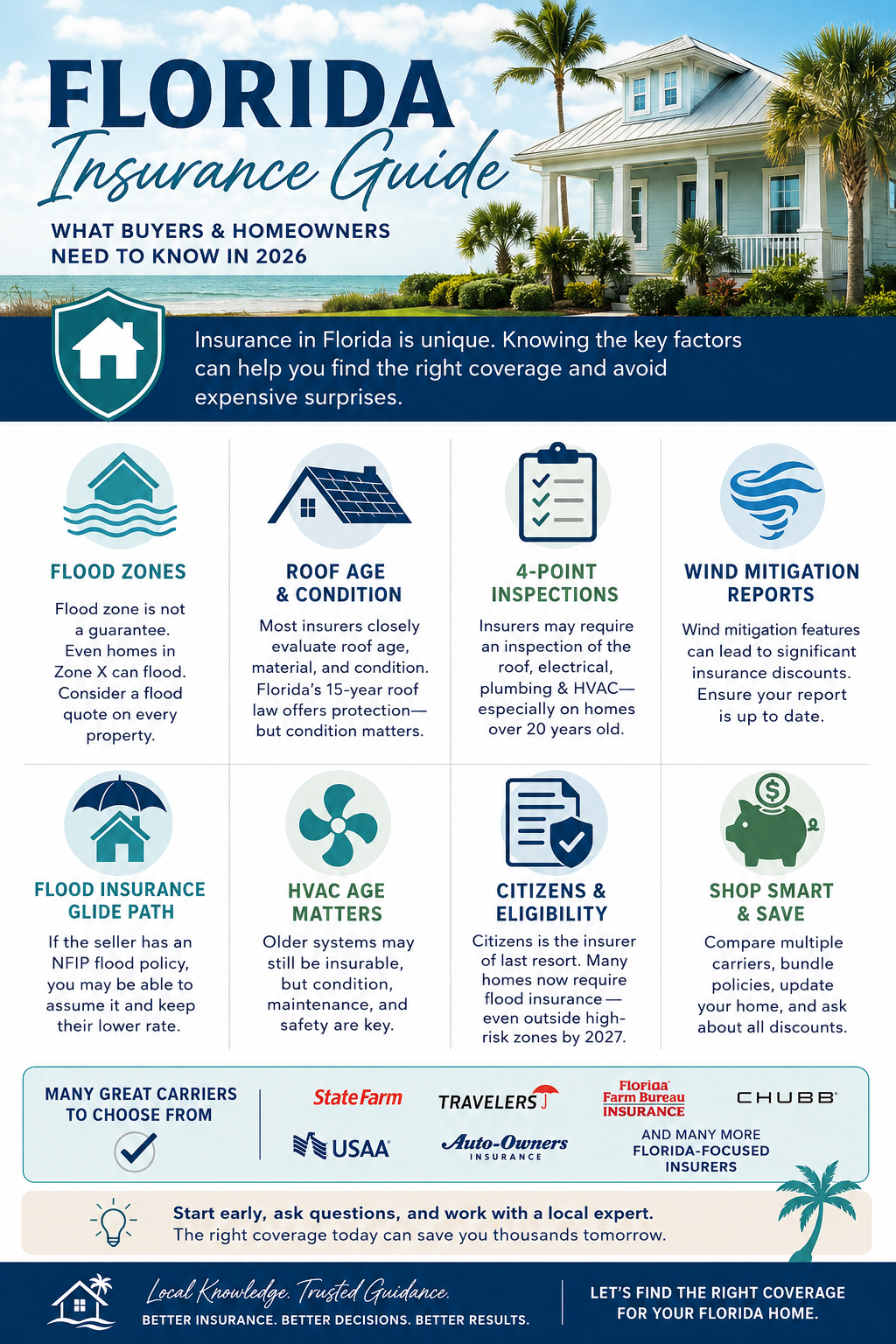
The 2026 Florida Home Insurance Guide
How Buyers and Homeowners Can Find Better Coverage and Avoid Expensive Surprises
Affordable homeowners insurance continues to be one of the most important issues affecting Florida real estate. Insurance costs can influence a buyer’s monthly payment, loan approval, purchasing power and even whether a property can successfully close.
The encouraging news is that Florida homeowners now have more insurance options than they did during the height of the recent insurance crisis. New companies have entered the market, some existing insurers have expanded their business, and a number of carriers have filed for rate reductions or no increases. However, eligibility and pricing remain highly property-specific. A company that offers an excellent premium on one home may decline another property a few streets away.
This guide explains the major factors that affect Florida homeowners insurance and the steps buyers and sellers can take to make a property easier and more affordable to insure.
Information is current as of August 2026. Insurance rules, underwriting guidelines and carrier availability can change. Buyers and homeowners should obtain advice and written quotes from a licensed Florida insurance agent.
Why Florida Home Insurance Is Different
Florida insurers must evaluate the possibility of hurricanes, wind damage, water losses, roof claims, flooding, litigation and the cost of rebuilding after a major storm.
As a result, insurers look at much more than the home’s purchase price. They may consider:
- The home’s location and distance from the coast
- The age, condition and type of roof
- Wind-mitigation features
- The age and condition of the electrical, plumbing and HVAC systems
- Prior insurance claims
- The home’s replacement cost
- Flood-zone designation and elevation
- Whether the home is owner occupied, seasonal, vacant or rented
- Pools, trampolines, certain animals and other liability exposures
- Short-term rental activity
- The applicant’s insurance history and, where permitted, insurance-related credit factors
Florida’s insurance market has shown signs of improvement. The Florida Office of Insurance Regulation reported that additional companies entered the residential market following recent reforms and that numerous homeowners insurers filed for rate decreases or no rate increase. Nevertheless, premiums remain significantly affected by the individual home, county, construction type and available carrier capacity.
Start the Insurance Process Early
Buyers should not wait until the end of the inspection period to investigate insurance.
Ideally, the buyer’s insurance agent should receive the property address, MLS information, seller disclosures, roof permits, prior inspection reports and other available documentation as soon as the buyer becomes seriously interested in the property.
For a financed purchase, the buyer should obtain an insurance estimate before finalizing the offer whenever possible. An unexpected premium of several thousand dollars can change the buyer’s debt-to-income ratio and monthly payment.
After the contract is accepted, the buyer should quickly obtain:
- A complete homeowners insurance quote
- A flood insurance quote, even when flood coverage is not required
- A four-point inspection when needed
- A wind mitigation inspection
- Confirmation that the roof and major systems meet underwriting requirements
- Confirmation that the insurer will bind coverage for the closing date
- Written confirmation of deductibles, exclusions and coverage limits
A preliminary quote is not the same as final approval. The premium or eligibility can change after the carrier reviews inspection reports, photographs, replacement-cost calculations, claims history or other underwriting information.
Understanding Florida Flood Zones
A flood zone is a geographic risk designation shown on a FEMA Flood Insurance Rate Map. It is not a guarantee that a property will or will not flood.
Special Flood Hazard Areas
Zones beginning with “A” or “V” are generally considered Special Flood Hazard Areas. These areas have at least a 1% annual chance of flooding, commonly described as the “100-year floodplain.” Federally regulated lenders generally require flood insurance when a financed property is located in one of these zones.
Common designations include:
Zone AE: A higher-risk flood area where FEMA has established a Base Flood Elevation.
Zone A: A higher-risk area where detailed Base Flood Elevation information may not be available.
Zone VE: A higher-risk coastal area subject to storm surge and wave action. Insurance and construction requirements can be more demanding in these locations.
Zone X
Zone X usually indicates a lower or moderate mapped flood risk. Flood insurance is not typically required by a federally regulated lender in an X zone, but flooding is still possible.
FEMA specifically cautions that lower risk does not mean no risk. Flooding can occur because of heavy rainfall, drainage problems, overflowing canals, storm surge, new development or a storm that exceeds the assumptions used in the map.
For that reason, Florida buyers should consider obtaining a flood quote regardless of the property’s mapped zone.
Flood Zone Is Only One Part of the Flood Rate
Under FEMA’s Risk Rating 2.0 system, an NFIP premium is not determined solely by the letter appearing on the flood map.
Pricing can also reflect:
- Distance from water
- Type of flooding
- Estimated flood frequency
- Property elevation
- Foundation and construction type
- Replacement cost
- Building characteristics
- The amount of coverage selected
- The property’s individual flood-risk profile
An elevation certificate can still be valuable, especially when confirming building elevation, supporting a map-change request or helping an insurance professional evaluate available options. However, an elevation certificate is not required for every NFIP quote.
Homeowners Insurance Does Not Normally Cover Flooding
A standard homeowners policy generally does not cover rising water, storm surge or water entering the home because of flooding.
Homeowners insurance and flood insurance are separate policies. A homeowner may need both following the same storm. For example, wind damage to the roof may fall under the homeowners policy while storm-surge damage may fall under the flood policy.
Flood coverage may be purchased through:
- The National Flood Insurance Program
- An NFIP Write Your Own insurance carrier
- A private flood insurance company
- In some cases, an excess flood policy for coverage above primary limits
Florida law permits private flood insurance products, including policies designed to provide coverage at least as broad as the NFIP and other customized flood products. Coverage forms, limits, exclusions and lender acceptance should be reviewed carefully.
Using the Seller’s Flood Insurance “Glide Path”
One of the most valuable and frequently overlooked opportunities in a Florida transaction may be the seller’s existing NFIP flood policy.
Under FEMA’s Risk Rating 2.0, some existing policyholders are paying less than the property’s full-risk premium. For most policies, federal law limits annual premium increases to no more than 18%. This gradual movement toward the full-risk rate is often called the flood insurance “glide path.”
When a property is sold, the buyer may be able to assume the seller’s existing NFIP building policy. The assumption can allow the buyer to continue along the seller’s existing premium glide path rather than beginning with a brand-new policy priced closer to the current full-risk rate. The potential savings can sometimes be substantial.
The policy does not automatically transfer. The buyer, seller and flood insurance agent must complete the required policy-assumption process.
Recommended Steps
The listing agent or seller should:
- Ask whether the seller has an active NFIP flood policy.
- Obtain the declarations page and current annual premium.
- Ask the seller’s flood insurance agent whether the policy is eligible for assumption.
- Determine whether the buyer must change coverage limits or contents coverage.
- Begin the transfer paperwork well before closing.
- Coordinate with the buyer’s lender and insurance agent.
- Confirm in writing when the assumption becomes effective.
The seller cannot take the property’s flood policy to a different home. The rating and coverage are tied to the insured property.
Private flood policies may have different transfer rules and may not be assumable. The parties must contact the issuing carrier.
Citizens’ Flood Insurance Requirement
Citizens Property Insurance Corporation has been phasing in a flood insurance requirement for many personal residential policies that include wind coverage.
Properties in FEMA Special Flood Hazard Areas are already subject to the requirement. For properties outside those higher-risk zones, the requirement has been phased in according to the insured replacement value of the dwelling.
For 2026, Citizens generally requires flood coverage for applicable new and renewing personal residential policies with wind coverage when the dwelling’s replacement cost is $400,000 or more. Beginning January 1, 2027, the requirement is scheduled to apply to the remaining applicable personal residential policies, regardless of replacement cost. Certain exceptions and policy types may apply.
Citizens does not itself provide the flood policy. The customer must obtain qualifying flood coverage through the NFIP or an acceptable private flood insurer.
Roof Age and Condition
The roof is one of the most important components in Florida insurance underwriting.
Carriers may evaluate:
- Roof age
- Roof-covering material
- Condition
- Remaining useful life
- Permit history
- Evidence of leaks or repairs
- Roof geometry
- Roof-to-wall attachment
- Secondary water resistance
- Whether the roof complies with newer building codes
Florida’s 15-Year Roof Rule
Florida law generally prohibits an insurer from refusing to issue or renew a homeowners policy solely because a roof is less than 15 years old.
When a roof is at least 15 years old, the insurer must generally allow the homeowner to obtain an inspection before requiring roof replacement. When the inspection establishes that the roof has at least five years of remaining useful life, the insurer may not refuse coverage solely because of the roof’s age. Other underwriting factors may still affect eligibility.
This law is helpful, but it does not require every insurer to accept every older roof. An insurer may still consider the roof’s condition, material, documentation, prior damage and other characteristics.
Citizens Roof Guidelines
Citizens’ guidelines are not identical to every private carrier’s rules. As of 2026, Citizens generally requires documentation of full roof replacement for:
- Shingle and similar roof coverings more than 25 years old
- Tile, slate, clay, concrete or metal roofs more than 50 years old
- Mobile-home roofs more than 25 years old
Citizens may accept qualifying documentation showing at least five years of remaining useful life in certain circumstances.
Private carriers may have stricter or more flexible standards. Some prefer newer roofs, particularly in coastal counties or areas with significant wind exposure.
Documentation Matters
A roof may be physically newer than county records indicate. Sellers should preserve:
- Finalized roofing permits
- Paid invoices
- Roofing contracts
- Material information
- Photographs
- Warranty information
- Inspection reports
- Proof that partial repairs were completed by a licensed contractor
An open permit or an unrecorded roof replacement can delay underwriting. Sellers should verify permit records before placing a home on the market.
HVAC Age and Condition
There is no single statewide HVAC age cutoff that applies to every Florida insurer.
Carriers generally focus on whether the system is operational, safely installed, properly maintained and free from visible hazards or active leaks. An older HVAC system may still be acceptable to one insurer and declined by another.
Underwriters may look for:
- The age of the air-conditioning and heating equipment
- Whether the system is functioning properly
- Evidence of rust, corrosion or water leakage
- Improper portable or space-heating equipment
- Unsafe wiring or electrical connections
- Signs of deferred maintenance
- Condition of the drain line and overflow protection
Systems approaching or exceeding their typical service life can reduce the number of available carriers, even when they are still working.
A buyer should not assume that a functioning air conditioner will automatically satisfy insurance underwriting. When the HVAC is old, buyers should obtain insurance approval before the inspection period expires.
Four-Point Inspections
A four-point inspection is an insurance-focused report evaluating four major areas of an older home:
- Roof
- Electrical system
- Plumbing system
- HVAC system
It is different from a general home inspection. A home inspection is primarily designed to help the buyer understand the overall condition of the property. A four-point inspection is designed to help an insurer decide whether the property meets its underwriting guidelines.
Different carriers require four-point inspections at different property ages. Citizens currently requires one for applicable owner-occupied, dwelling and mobile-home applications when the property is more than 20 years old. The report must identify the age, type and condition of the roof, electrical, plumbing and HVAC systems. Citizens generally requires the report to have been completed within the previous 12 months for new business.
Other insurers may request a four-point inspection for homes that are 20, 25, 30 or 40 years old, or whenever underwriting determines that additional documentation is needed.
Common Four-Point Problems
Insurance issues commonly include:
- Active roof leaks
- Deteriorated roofing
- Insufficient roof remaining useful life
- Federal Pacific, Zinsco or other disfavored electrical panels
- Aluminum branch wiring without acceptable remediation
- Cloth-covered wiring
- Double-tapped breakers
- Exposed wiring
- Fuses or inadequate electrical service
- Polybutylene plumbing
- Galvanized plumbing with deterioration or active leaks
- Deteriorated cast-iron drain lines
- An older or nonoperational water heater
- Active plumbing leaks
- An inoperable or unsafe HVAC system
- Evidence of unrepaired water damage
Carrier guidelines vary. A condition that is unacceptable to one company may be eligible with another carrier, after repairs or with additional documentation.
Repairs should be performed by an appropriately licensed professional, and the owner should retain invoices, photographs and permits.
Wind Mitigation Reports
A wind mitigation inspection identifies construction features that may help a home withstand hurricane-force winds.
Unlike a four-point inspection, which primarily addresses insurability, a wind mitigation inspection is usually completed to qualify the homeowner for insurance discounts.
The inspector may document:
- The year the home was built
- Applicable building code
- Roof-covering installation date and code compliance
- Roof-deck attachment
- Roof-to-wall connections
- Roof geometry
- Secondary water resistance
- Protection of windows, doors and garage doors
- Whether all openings have qualifying hurricane protection
Florida insurers must recognize qualifying wind-mitigation features in their rating plans, although the amount of the discount varies. A properly completed report may produce meaningful savings.
The largest discounts often come from a combination of strong roof attachments, a hip-shaped roof and complete opening protection. “Complete” opening protection generally means every required glazed opening, exterior door and garage door meets the applicable standard—not simply that the home has shutters stored in the garage.
Buyers should ask for the seller’s current wind mitigation report. If the roof or protection features have changed, a new inspection may be beneficial.
Electrical and Plumbing Concerns
Many insurance difficulties involving older Florida homes are not caused by the home’s age itself. They are caused by outdated systems, unsafe components or incomplete documentation.
Electrical concerns may include outdated panels, aluminum branch wiring, cloth wiring, improper connections, insufficient amperage and do-it-yourself modifications.
Plumbing concerns may include polybutylene supply lines, deteriorated galvanized pipes, aging cast-iron drain lines, active leaks and older water heaters.
A buyer purchasing an older home should consider having specialized electrical, plumbing or sewer-line inspections when the general inspection identifies concerns. Insurability and physical condition are related, but they are not the same question.
Replacement Cost Is Not Market Value
The amount for which a home is insured is usually based on the estimated cost to rebuild it—not its purchase price, tax assessment or current resale value.
Replacement-cost calculations can include:
- Current labor and material costs
- Demolition and debris removal
- Building-code upgrades
- Contractor demand after a catastrophe
- The home’s square footage
- Construction quality
- Architectural features
- Attached structures
- Local rebuilding costs
A modest home on a valuable waterfront lot may have a high purchase price but a lower building replacement cost. Conversely, an older home with custom construction may cost substantially more to rebuild than its market value suggests.
Buyers should review Coverage A and make sure the carrier has accurate information about the home.
Hurricane Deductibles
Florida homeowners policies commonly include a separate hurricane deductible.
Unlike a standard flat deductible, the hurricane deductible is often expressed as a percentage of the insured dwelling limit. For example, a 2% hurricane deductible on a home insured for $400,000 would equal $8,000.
Buyers should compare:
- Hurricane deductible
- All-other-perils deductible
- Roof deductible, when applicable
- Water-damage deductible
- Sinkhole-related coverage and deductibles
- Whether the hurricane deductible applies once per calendar year or differently under the policy terms
The least expensive premium is not always the least expensive policy after a loss.
Water-Damage Coverage
Water losses are a major underwriting concern in Florida. Some lower-cost policies may limit water-damage coverage, exclude certain losses or offer reduced limits.
Buyers should ask:
- Is sudden and accidental water damage covered?
- Is there a water-damage sublimit?
- Is coverage available for hidden water damage?
- Is mold coverage included, and at what limit?
- Is sewer or drain backup covered?
- Is service-line coverage available?
- Are older plumbing materials excluded?
- Does the policy pay replacement cost or actual cash value for damaged property?
Flooding, storm surge, surface water and rising water normally require separate flood insurance.
Actual Cash Value Versus Replacement Cost
Replacement-cost coverage generally pays the cost to repair or replace covered property without deducting for age and depreciation, subject to policy terms and limits.
Actual cash value coverage subtracts depreciation. This can significantly reduce a claim payment, particularly for an older roof.
Some Florida policies may provide replacement-cost coverage for the dwelling but actual cash value for certain roof losses or personal property unless additional coverage is purchased.
The buyer should review this carefully instead of comparing premiums alone.
Citizens Property Insurance Corporation
Citizens is Florida’s state-created insurer of last resort. It plays an important role when qualifying property owners cannot obtain acceptable coverage in the private market.
Citizens is not automatically the least expensive or best option. Its coverage terms, deductibles, flood insurance requirements, assessments and depopulation process should be considered.
A property may generally be ineligible for Citizens when the customer receives a qualifying private-market offer within the percentage allowed under Florida law and Citizens’ eligibility rules. Citizens customers may also receive offers from private insurers through the state’s depopulation or take-out process.
Citizens policyholders may face assessments following major losses if Citizens’ resources are insufficient. Buyers should discuss these potential assessments and policy limitations with their insurance agent.
Major Types of Florida Insurance Carriers
Florida consumers may obtain quotes from several different categories of insurers.
National and Regional Carriers
Depending on eligibility and location, options may include companies or affiliated insurers associated with:
- State Farm
- USAA
- Travelers
- Progressive or ASI
- Auto-Owners
- AAA or Auto Club
- Chubb
- Nationwide-related programs
- Farmers-related programs
- Florida Farm Bureau
Some national carriers have limited eligibility, geographic restrictions, bundling requirements or highly selective underwriting.
Florida-Focused and Specialty Homeowners Carriers
Companies active in Florida have included:
- Universal Property & Casualty
- Slide Insurance
- Tower Hill Insurance Exchange
- Florida Peninsula
- Edison Insurance
- Security First
- American Integrity
- Heritage Property & Casualty
- People’s Trust
- Homeowners Choice
- TypTap
- Kin Interinsurance Network
- Olympus
- Loggerhead
- VYRD
- American Traditions
- Southern Oak
- Florida Family
- SafePoint
- Centauri
- Monarch National
- Trusted Resource Underwriters Exchange
- Other newly authorized or expanding insurers
The Florida Office of Insurance Regulation maintains residential market-share reports and insurer information. A company’s inclusion in the Florida market does not mean it is accepting every type of home, writing in every county or offering coverage through every agency.
Surplus Lines Carriers
When a property does not qualify for the standard admitted market, a licensed agent may seek coverage through the surplus lines market.
Surplus lines policies can provide valuable coverage for unusual, coastal, high-value, older or otherwise difficult-to-insure properties. However, these policies may have different forms, exclusions and consumer protections. They are generally not backed by the Florida Insurance Guaranty Association in the same way as policies issued by admitted carriers.
The buyer should carefully review the carrier’s financial strength, coverage form, exclusions and deductibles.
Florida Farm Bureau and Smaller Insurers
Homeowners should not overlook smaller, regional, membership-based or less heavily advertised companies.
For example, my own Florida home is insured through Florida Farm Bureau for under $1,000 per year. That is my individual experience and not a promise of pricing or eligibility for another property, but it demonstrates why buyers should shop beyond the most familiar national brands.
Florida Farm Bureau may have membership requirements, property guidelines, geographic limitations or bundling considerations. Like every insurer, its pricing will depend on the home, applicant, coverage limits, deductibles and underwriting criteria.
A strong independent insurance agent can often compare multiple Florida-focused carriers that a consumer may not encounter through television advertising or a basic online search.
What “Affordable” Insurance Really Means
The lowest premium is not necessarily the best value.
A well-structured policy should balance:
- Financial strength of the insurer
- Dwelling replacement-cost coverage
- Hurricane and other deductibles
- Roof settlement provisions
- Water-damage coverage
- Personal property coverage
- Loss-of-use coverage
- Liability protection
- Ordinance or law coverage
- Flood protection
- Exclusions and limitations
- Claims service
- Premium affordability
A policy that saves $700 per year but leaves the homeowner with a $15,000 coverage gap may not be the better policy.
Ways to Reduce Florida Insurance Costs
Homeowners and buyers may be able to improve pricing by:
- Comparing several carriers
- Working with an independent insurance agent
- Bundling home and automobile coverage when beneficial
- Increasing deductibles responsibly
- Obtaining an updated wind mitigation inspection
- Installing qualifying impact windows or shutters
- Strengthening garage doors and exterior openings
- Replacing an aging or damaged roof
- Installing a secondary water barrier during reroofing
- Updating unsafe electrical panels or wiring
- Replacing problematic plumbing
- Installing monitored burglar, fire or water-leak detection systems
- Maintaining continuous insurance coverage
- Correcting inaccurate public records
- Providing roof permits, invoices and inspection reports
- Comparing NFIP and private flood insurance
- Asking whether the seller’s NFIP policy can be assumed
- Reviewing quotes annually instead of automatically renewing
- Considering a home’s insurability before making an offer
Homeowners should never cancel an existing policy until replacement coverage has been approved, bound and confirmed in writing.
Advice for Florida Sellers
Insurance preparation can make a home more marketable and reduce the risk of a failed transaction.
Before listing, sellers should consider gathering:
- Current homeowners declarations page
- Current flood declarations page
- Roof permits and invoices
- Four-point inspection
- Wind mitigation report
- Elevation certificate
- HVAC installation records
- Electrical and plumbing update documentation
- Hurricane shutter or impact-glass documentation
- Prior claim information and proof of completed repairs
- Information about the seller’s assumable NFIP flood policy
Sellers should address open permits, active leaks, electrical hazards and visibly deteriorated systems before the buyer’s insurance inspection.
When a seller has a favorable NFIP premium, preserving and transferring the policy may become a valuable marketing benefit.
Advice for Florida Buyers
Before the inspection period expires, buyers should know:
- Whether the home is insurable
- The estimated annual homeowners premium
- The estimated flood premium
- The hurricane deductible
- Whether a four-point inspection is required
- Whether the wind mitigation report is current
- Whether the roof meets carrier guidelines
- Whether the electrical, plumbing and HVAC systems are acceptable
- Whether water damage is limited
- Whether the roof is covered at replacement cost or actual cash value
- Whether the home qualifies for more than one carrier
- Whether the seller has an NFIP policy that can be assumed
- Whether the quote is fully underwritten or merely preliminary
Insurance should be treated as part of the home’s total cost of ownership—not as an item to handle a few days before closing.
A Smart Florida Insurance Timeline
Before Making an Offer
- Review the FEMA flood map.
- Ask about roof age and permits.
- Request existing inspection reports.
- Obtain an initial homeowners and flood estimate.
- Consider insurance costs when calculating the monthly payment.
Immediately After Contract Acceptance
- Order the home inspection.
- Order a four-point inspection if needed.
- Obtain or update the wind mitigation report.
- Send all reports to the insurance agent.
- Obtain quotes from multiple carriers.
- Investigate the seller’s flood policy and glide path.
Before the Inspection Period Ends
- Confirm the property is eligible for coverage.
- Understand required repairs.
- Negotiate repairs or credits when appropriate.
- Confirm the expected premium and deductibles.
- Discuss any insurance issue that could affect financing.
Before Closing
- Select the carrier.
- Complete all required applications and disclosures.
- Provide proof of flood coverage when required.
- Complete any NFIP policy-assumption paperwork.
- Confirm the effective date.
- Provide the insurance binder and paid receipt to the lender or closing agent.
- Verify that coverage begins no later than the date ownership transfers.
Questions to Ask an Insurance Agent
- Which admitted carriers are currently writing this type of home in this county?
- Is this quote final, or is it subject to inspection and underwriting review?
- What roof age and remaining-useful-life requirements apply?
- Is a four-point inspection required?
- Will the wind mitigation report generate discounts?
- Does the policy cover the roof at replacement cost or actual cash value?
- Is water damage limited?
- What are the hurricane and all-other-perils deductibles?
- Is ordinance or law coverage included?
- Does the policy include loss-of-use coverage?
- Is flood insurance required by the lender or Citizens?
- Should we compare private flood insurance with the NFIP?
- Can the buyer assume the seller’s NFIP policy?
- Are there exclusions for plumbing, animals, pools, vacancy or short-term rentals?
- Is the company admitted in Florida?
- Is the carrier covered by the Florida Insurance Guaranty Association?
- Are any inspections or repairs required after closing?
- Could bundling home and auto reduce the total premium?
- Are there discounts for alarms, leak detection, impact glass or shutters?
- Are there other carriers that may offer stronger coverage, even if the premium is slightly higher?
Final Thoughts
Florida homeowners insurance is not one-size-fits-all. The best carrier for a newly constructed inland home may not be the best carrier for an older coastal property, condominium, seasonal residence or waterfront home.
The most effective strategy is to begin early, gather accurate documentation and compare multiple options. Roof condition, wind protection, flood coverage and the age of major systems can have as much influence on insurability as the home’s location.
Affordable coverage may still be available—even when the first quote is discouraging. The key is working with knowledgeable real estate and insurance professionals who understand Florida’s rapidly changing market and who are willing to investigate every reasonable option.
This guide is provided for general educational purposes and is not legal, insurance, tax or financial advice. Coverage, premiums, underwriting guidelines and carrier availability can change without notice. Consumers should consult a licensed Florida insurance agent and review the actual policy documents before making a decision.
Written By Tracy Jones
REALTOR & Broker Associate
White Sands Realty Group
(941)376-3405
www.941.realestate
realtortracyjones@gmail.com

Michael Burke
| White Sands Realty Group Florida
or another way